
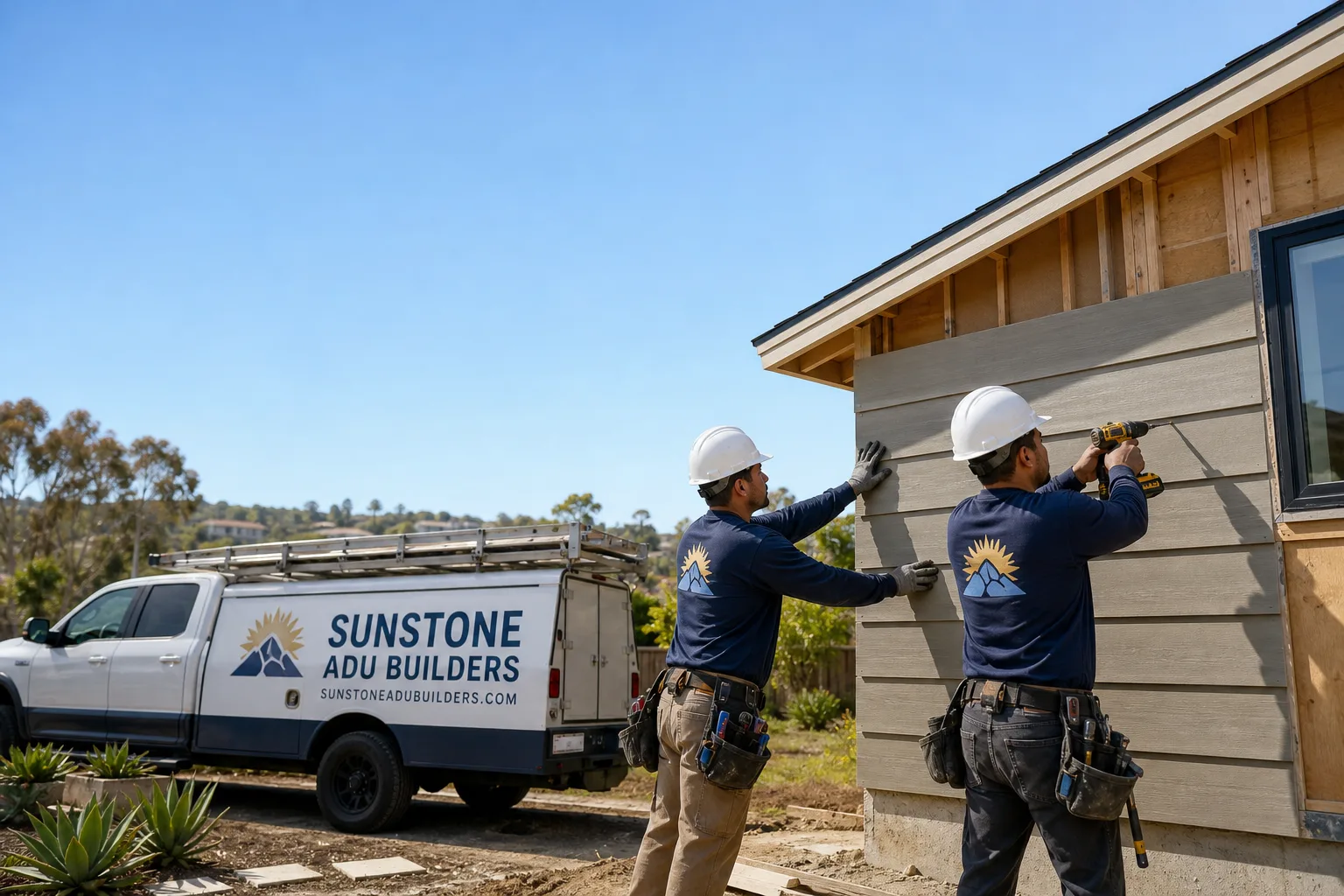
Fast, Reliable ADU Builders Across Banning
Most Banning homeowners we talk to are surprised by one thing: an accessory dwelling unit here isn’t just about square footage and finishes. It’s about wind. Banning sits directly in the San Gorgonio Pass wind funnel, where sustained gusts off the I-10 corridor shape every structural decision on a detached build. We know this because we’ve built here, and we’ve seen what standard fastening does after the first real gust event. If you’re planning a backyard unit in Banning, call us at (855) 949-1913 and we’ll walk the site with you before you spend a dollar on plans.
We’re Sunstone ADU Builders, a dedicated ADU Builders specialist serving Banning and the surrounding pass communities. This isn’t a side service for us. It’s the entire job. And in Banning specifically, the job starts with understanding what the wind does to a structure here, not just what the building department wants on paper.
Why Sunstone ADU Builders Is Banning’s Preferred ADU Builders Company
Banning homeowners call us because we show up already knowing their street, their setback problems, and their HOA constraints. The older stucco ranch homes off Sunset Avenue, the Sun Lakes-area subdivisions with their design review boards, the larger infill lots west of the 10, and the wind-blasted flats near the pass: each pocket of Banning demands a different ADU strategy. We don’t treat Banning as one generic market. We treat it as a set of specific sites, each with its own wind exposure and its own path through the city.
The proof is in how our Banning projects actually hold up. One recent detached unit off the older single-story core near Sunset Avenue had shingle tabs lifting and sand packing into the HVAC return within months of installation, done by a builder who treated Banning like any inland city. We re-specified the roof with a high-wind-rated system, upgraded the fasteners, added continuous shear-wall hold-downs and gust-rated ties at every anchor point, and sealed and oriented the unit to break the wind tunnel before final inspection. It held through the next major gust event with zero shingle lift and a clean HVAC intake. That’s the difference between a builder who reads the code and one who understands the pass.
Sunstone is led by Nate Holloway, and when Nate walks a Banning site, he’s looking at wind direction before he looks at the floor plan. That order of priorities is exactly why Banning homeowners keep our number.
ADU Design in Banning
ADU Design in Banning means designing for wind before you design for anything else. The San Gorgonio Pass isn’t occasional weather here; it’s a structural condition. Gusts that would never register as a concern in Beaumont’s sheltered flats or Palm Springs’ calmer valley floor routinely push 50 to 70 mph through the corridor. So the design conversation starts with roof slope, anchoring, and unit orientation, not paint colors or cabinet pulls. A well-designed Banning ADU accounts for sustained lateral pressure, uplift on the roof assembly, and dust intrusion through every penetration.
Wind-Rated Roofing and Shear Strategy
Detached units in Banning need a roof system specified for high-wind uplift, which usually means upgraded fastening patterns, a secondary water barrier, and often a higher-rated shingle or standing seam alternative. Shear walls need to be engineered for the actual lateral load the pass delivers, not the minimum the state code presumes. We specify James Hardie fiber cement siding on most Banning exteriors because it stands up to blowing sand better than vinyl or thin composite cladding.
Orientation and Dust Sealing
Where the unit sits on the lot matters as much as what it’s made of. A detached ADU placed directly in the wind tunnel along the I-10 alignment will eat sand, pit its exterior finishes, and clog the HVAC return inside a season or two. We design for windbreak effects using the main home, existing walls, or deliberate unit orientation. Then we seal it: every penetration, every sill plate, every duct connection. The gap that would be cosmetic in West LA is a maintenance liability in the pass.
Backyard ADU in Banning
A Backyard ADU in Banning is the single best way to add usable space on the older core’s large, underused lots, but only if the structure is anchored like it’s meant to stay. The mid-century single-story stucco ranches off streets like Sunset Avenue and Wilson Street often sit on parcels with real backyard room, which makes a detached unit genuinely viable. The catch is that a detached structure has no shared wall with the main house, so every pound of wind pressure hits the frame, the roof, and the tie-downs directly. The trick is engineering that in from the first drawing, not patching it after the first gust event.
Detached Units on the Older Core Lots
These are the classic Banning opportunities: a 1950s or 60s ranch on a deep lot, alley access, and no HOA to fight about placement. A well-engineered detached ADU here can add rental income or house a family member for decades. The budget needs to include the wind package: shear walls on both axes, hold-downs that run continuous, and a roof system that’s rated for sustained uplift. In Banning, a typical detached ADU project runs $220,000 to $380,000 depending on size, site prep, and whether the unit is stick-built or uses a prefab platform from Abodu, Cover, or Dvele.
HOA Lots and Attached Alternatives
Sun Lakes-area properties are a different story. The HOAs there have lot constraints and design standards that often make a full detached unit impractical or outright unapprovable. In those cases, we pivot to garage conversions or attached units, which sidestep the setback fights and still deliver a complete rental-ready space with its own kitchen and bath. The conversation is always: what does your site actually allow, and what does the wind actually demand?
Trusted Brands We Service in Banning
We’re an authorized builder and installer for several prefab ADU brands that make sense for pass-area sites, including Cover, Dvele, and Boxabl. Prefab isn’t right for every Banning lot, but when the site is straightforward and the access is workable, these factory-built shells can cut months off the build timeline and deliver consistent quality a site-built ADU can’t always match. We also build traditional stick-frame units when the lot geometry, HOA standards, or wind exposure call for it. Prefab or traditional, whichever works for your site. We stock the components and hardware Banning inspections actually require, so you’re not waiting on a resupply order while the wind season gets closer.
Common ADU Builders Problems We See in Banning Homes
- Shingle lift and roof uplift after the first pass wind event. A roof fastened to standard California code but not engineered for San Gorgonio Pass gusts will start losing shingle tabs within the first season. The repair means redoing the roof assembly, not just tacking down a few tabs.
- Dust intrusion through unsealed penetrations and poorly placed HVAC intakes. Blowing sand from the pass gets into every gap. After a Santa Ana event, a badly sealed ADU will have sand in the return ducts and pitted exterior finishes, which is a maintenance spiral from the first month.
- Shear walls and hold-downs spec’d to generic code minimums. The state code assumes a generic wind zone. Banning’s actual wind loads exceed that in many locations, and a unit that passes plan check but lacks full shear-wall continuity will rack under lateral pressure.
- Designing a detached unit on an HOA lot that never had a chance. Sun Lakes-area design review boards don’t rubber-stamp big detached structures. Clients who get standard detached plans drawn before checking their CC&Rs waste permit fees and months of delay, when a garage conversion or attached unit would have been approvable from the start.
Pricing for ADU Builders in Banning, CA
Let’s be straight about what a compliant Banning ADU costs, because a cheap quote that skips the wind engineering isn’t cheap. A detached stick-built ADU on a typical Banning lot runs $250,000 to $400,000 depending on square footage, site access, and whether the lot demands extra shear-wall framing. A prefab ADU using a brand we carry, like Cover or Dvele, typically lands between $220,000 and $350,000 once you add the Banning-specific foundation anchoring, site work, and utility runs. An attached unit or garage conversion in a Sun Lakes-area HOA runs lower, usually $160,000 to $260,000, because the structure already has a roof and walls doing some of the work. What moves the number the most in Banning isn’t finishes. It’s soil and wind: the amount of anchoring, shear reinforcement, and roof system the site actually needs. Call (855) 949-1913 for a free written line-item estimate, and we’ll give you a number that includes the wind package from day one, not as a change order later.
We Also Serve Cities Near Banning
Our ADU Builders in Banning team also covers Cabazon just east, Calimesa to the west, Yucaipa up the hill, and Valle Vista to the southeast. The wind profile changes block by block in this region, and we adjust the engineering accordingly. If you’re in one of these nearby communities, the same free estimate and the same license apply.
Serving Banning, CA — Our Local Coverage Area
We’re based in the Banning area and know this community well. Use the map below to see our service coverage — if you’re nearby, we can almost certainly help.
FAQs About ADU Builders in Banning
Because Banning sits in the San Gorgonio Pass wind funnel, where sustained and gust winds off the I-10 corridor regularly exceed what Beaumont’s sheltered flats or Palm Springs’ calmer valley floor ever see. The structural demands here are closer to a mountain pass than a desert basin, so the roof uplift, lateral shear, and anchor loads all get engineered differently. A builder who copies a Beaumont spec to Banning is handing you a roof that lifts and walls that rack. Call (855) 949-1913 and we’ll explain what your specific lot actually requires.
A real Banning quote includes wind-rated roofing with upgraded fastening, continuous shear-wall hold-downs, gust-rated ties at every anchor, and dust sealing at all penetrations and HVAC connections. The cheap quote shows a generic roof assembly, standard fastening, and no mention of dust sealing because the builder has never worked a full pass wind season. The line items that protect an insurance claim later are the ones cheap bidders don’t even know to write down.
Usually yes, and those older stucco ranch lots off streets like Sunset Avenue are some of the best ADU candidates in the city. The yard space is there, the setbacks are often workable, and there’s typically no HOA to restrict a detached footprint. The main condition is structural: the unit needs genuine wind engineering and anchoring, not code-minimum fastening. We handle that as part of the standard build.
It depends on your lot’s specific CC&Rs and the design review board, but in most Sun Lakes-area subdivisions a full detached unit is difficult to get approved. A garage conversion or attached unit is almost always the more realistic path, and it usually costs less because the existing structure already does part of the structural work. We’ll review your HOA documents before you spend a dollar on plans.
If a wind event damages your Banning ADU and the insurer asks whether the structure was built to the local wind standard, you want documentation that says yes, with the specific roof rating, anchor schedule, and shear-wall hold-downs listed. A unit built without that paper trail is an easy claim denial. We document every wind-related spec and inspection result, so your insurance file shows compliance, not a gap. Call (855) 949-1913 for a free estimate on a unit that’s built to hold up in the pass from day one.
Written by Nate Holloway, Owner at Sunstone ADU Builders, serving Banning and the San Gorgonio Pass communities.