
Last updated October 30, 2026
DIY vs Professional ADU: The Aliso Viejo Homeowner’s Decision Guide
Here’s a fact most ADU guides won’t tell you: California grants owner-builders the legal right to pull their own permits, but that same law holds you personally liable for code compliance for a minimum of four years after completion, and your homeowner’s insurance may silently exclude claims on work you performed yourself. In Aliso Viejo, where lot slopes, HOA overlays, and hillside setback rules complicate even “simple” backyard projects, this liability lands differently than it does on flat suburban lots elsewhere. This guide walks through the real tradeoffs of DIY versus professional ADU construction, the specific tasks where sweat equity genuinely pays, the tasks that become financial traps, and what Aliso Viejo’s permitting process looks like from both sides of the counter. For more guidance, see our How to Hire a ADU Contractor in Aliso Viejo: A Step-by-Step Guide.
Quick Answer
DIY ADU construction in Aliso Viejo makes financial sense for a narrow set of skilled homeowners handling limited finish work under a properly permitted owner-builder plan, but professional management produces better ROI for the full project for most people, because permit sequencing, trade coordination, and code-critical rough work mistakes typically cost more to fix than the initial savings. The break-even point is murkier than most calculators suggest, because the expensive failures show up at inspection, at resale, or on an insurance claim, not in the first framing weekend.
Table of Contents
- What Owner-Builder Status Really Means in California
- Where DIY Genuinely Saves Money (and Where It Doesn’t)
- The Aliso Viejo Permit Process: Owner-Builder vs. Licensed Contractor
- The Real Cost of a Stalled DIY ADU
- A Realistic Self-Assessment: Do You Have What This Project Actually Requires?
- How Prefab ADUs Change the DIY Equation
- Common Mistakes to Avoid
- When to Call a Professional
- Frequently Asked Questions
- The Bottom Line
What Owner-Builder Status Really Means in California
When you pull an owner-builder permit in California, you’re signing a document that declares you are the contractor of record. This isn’t a formality. It means you personally certify that all work meets current California Building Code, you’re responsible for worker safety on site, and you carry the legal exposure if something goes wrong. In Aliso Viejo, the city adds its own layer: owner-builder applicants must appear in person for plan review appointments, and the Building Division runs a stricter pre-issuance checklist for owner-builder ADU permits than it does for licensed contractor applications.
The insurance implications rarely come up in online forums, but they should be the first thing you check. Many homeowner policies in Orange County exclude liability for construction performed by the policyholder. If a helper gets injured on your DIY ADU site and your policy has an owner-builder exclusion, you’re personally exposed. Some carriers will issue a builder’s risk rider for owner-builder projects; others will flat-out decline. Before you swing a hammer, call your agent and ask one specific question: “Does my current policy cover owner-builder construction claims, including worker injury, for a detached ADU?” Get the answer in writing.
There’s also the resale disclosure requirement to consider. When you sell a home in Aliso Viejo, California’s transfer disclosure laws require you to disclose unpermitted work and any active owner-builder claims against the property. Work that was permitted under owner-builder status but later fails inspection creates a chain of liability that follows the title. We’ve seen this play out in escrow more than once. The buyer’s inspector flags something, the seller can’t produce clean permit sign-offs, and the deal either dies or gets renegotiated at a discount that dwarfs whatever the original DIY savings were.
Where DIY Genuinely Saves Money (and Where It Doesn’t)
Let’s be honest about where sweat equity actually works. A homeowner with genuine construction experience can safely save money on specific finish-scope items without taking on significant code or structural risk. The table below separates ADU work into three categories: DIY-sensible, DIY-risky, and DIY-foolish for the typical Aliso Viejo homeowner.
- DIY-sensible (low risk, meaningful savings): interior painting, finish carpentry (baseboards, casing, shelving), landscaping around the unit, appliance installation where connections already exist, door hardware, basic tile backsplash work, and final cleaning.
- DIY-risky (proceed only with demonstrated skill): drywall hanging and taping, flooring installation, kitchen cabinet assembly and mounting, basic electrical fixture swaps, plumbing trim-out (faucets, fixtures), and weatherproofing details around windows and doors.
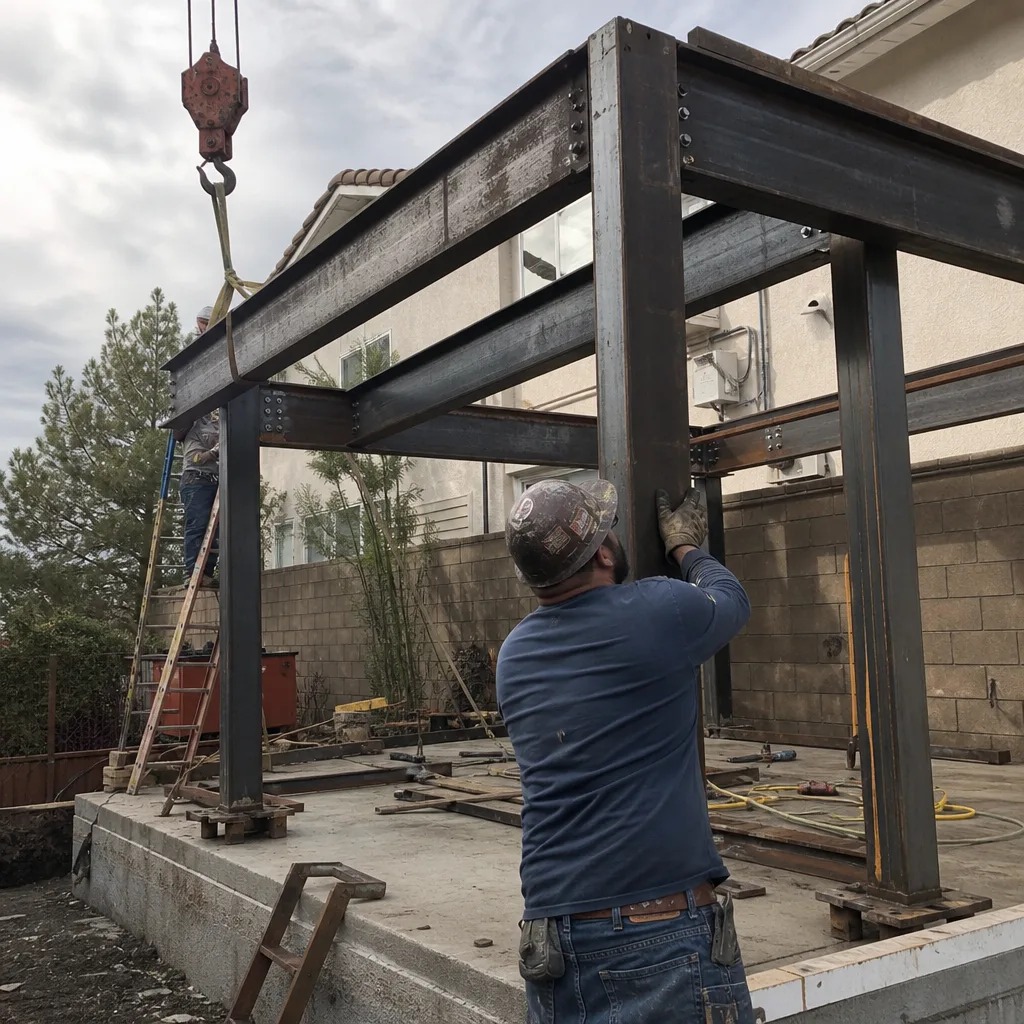
- DIY-foolish (hire licensed professionals, period): foundation work on Aliso Viejo’s sloped and often expansive soils, structural framing, roof assembly, any electrical panel work or new circuit runs, gas line installation, sewer and drainage connections, insulation and air sealing that affects energy code compliance, and fire-rated wall assemblies where the ADU sits close to a property line.
The reasoning behind the “foolish” category deserves emphasis. Aliso Viejo sits in a high-fire-risk zone, which means exterior wall assemblies, eave details, and window glazing on ADUs often require specific fire-resistant components. Get that wrong, and the inspector catches it at rough inspection, which means tear-out and redo, or the inspector misses it and you’ve created a long-term safety liability. Either way, the same $3,000 you saved doing framing yourself becomes a $7,000 correction.
One more honest point: the trades don’t price work the way homeowners assume. A licensed electrician running a 100-amp subpanel to a detached ADU in Aliso Viejo charges what they charge because they’re pulling the permit, scheduling the inspection, and standing behind the work. You cannot replicate that scope as an unlicensed owner-builder without taking on liability you don’t fully understand.
The Aliso Viejo Permit Process: Owner-Builder vs. Licensed Contractor
Here’s how the two paths actually differ in Aliso Viejo, step by step. The sequence is similar, but the friction points and timeline expectations differ enough to matter.
Owner-Builder Path:
- Pre-application review. You submit your ADU concept to the City of Aliso Viejo Building Division. You’ll meet with a planner and a plan checker who will flag obvious issues with setbacks, height limits, or HOA restrictions. This meeting is educational but nothing gets approved yet.
- Full plan submission. You either hire a designer or architect to produce construction documents, or in rare cases you produce them yourself. The city requires sealed engineering for foundation and structural elements regardless of who draws them. This is non-negotiable.
- Plan check cycles. Expect two to three review cycles for a first-time owner-builder. Aliso Viejo plan checkers are thorough about hillside grading, drainage, and fire-resistant construction details. Each correction cycle adds two to four weeks.
- Permit issuance. You sign the owner-builder declaration. You’re now legally responsible for everything that happens on the site.
- Inspections. You call for each required inspection (foundation, rough framing, rough electrical, rough plumbing, insulation, final). Missed details trigger reinspection fees and scheduling delays of one to two weeks per failure.
- Final sign-off. When the final passes, you get your certificate of occupancy. The liability clock starts running from this date.
Licensed Contractor Path:
- Site assessment and feasibility. A builder walks the lot, checks utility access, confirms setbacks, and gives you a reality-based budget. At Sunstone ADU Builders, this stage includes a written assessment of whether prefab or traditional construction fits your site better.
- Design and engineering. The builder’s preferred designers and engineers produce plans built around code requirements they already know. Plan check comments are usually addressed before submission because the team has seen the same redlines dozens of times.
- Permit submission and plan check. Licensed contractors with ADU experience in Aliso Viejo typically pass plan check in one or two cycles. The city’s review staff knows their work, and their plans arrive with fewer errors.
- Construction and inspections. The contractor schedules and manages all inspections. Trade coordination happens on the builder’s schedule, not yours. Failed inspections are corrected at the contractor’s cost when it’s a workmanship issue.
- Final sign-off and close-out. You receive a warranty package, as-built documentation, and a clean permit history.
The timeline difference is not subtle. An experienced contractor completing an ADU in Aliso Viejo typically finishes in six to nine months from permit submission to final sign-off. An owner-builder working weekends on the same project often takes twelve to eighteen months, not because the work itself takes longer but because each step only advances when you have time to move it forward.
We should also note that Aliso Viejo, like all Orange County cities, processes ADU permits under California’s streamlined ADU mandate. The state law says the city has 60 days to complete plan review. In practice, a clean application from a known contractor gets approved faster than an owner-builder submission with amateur-level omissions that trigger resubmittal requests.
The Real Cost of a Stalled DIY ADU
Nobody starts a DIY ADU expecting it to stall. But the patterns are predictable. The foundation gets poured, framing goes up, and then the project hits a wall: an electrical rough-in detail the homeowner doesn’t understand, a window order that arrived wrong, a plumbing vent that doesn’t fit where the plans said it would. Work stops. The site sits exposed to weather. Months pass.
Here’s what that stall actually costs on a typical Aliso Viejo detached ADU:
- Carrying costs: If you financed the project with a construction loan or HELOC, interest keeps accruing whether work is happening or not. On a $150,000 draw, a six-month stall adds roughly $5,000 to $6,000 in interest alone.
- Lost rental income: A one-bedroom ADU in Aliso Viejo rents for $2,400 to $2,900 per month. Every month the unit isn’t finished is a month of rent you’ll never recover. A six-month stall costs $14,400 to $17,400 in lost income.
- Weather exposure: An unfinished shell exposed to rain, morning marine layer moisture, and summer sun degrades materials. Framing lumber that sits wet develops mold and warping. Roof underlayment that isn’t dried in properly starts to fail. The correction cost grows every month.
- Re-engagement premium: When a professional takes over a partially completed ADU, they charge more than they would for a clean start. They have to verify what’s already been done, pull any unauthorized work, and warranty only what they can see. This premium typically runs 10% to 20% over standard pricing.
- Permit expiration risk: In Aliso Viejo, building permits expire if work is abandoned for a set period. Letting your permit lapse means starting the review process over with a fresh application and new plan check fees.
The stall scenario is the hidden cost most DIY calculators ignore. They compare materials and labor rates on a completed project, but they assume the project completes. When it doesn’t, the math collapses in a way that’s hard to recover from.
A Realistic Self-Assessment: Do You Have What This Project Actually Requires?
Before you decide between DIY and professional construction for your Aliso Viejo ADU, run yourself through this framework. Answer honestly. The point isn’t to talk you out of anything. It’s to make sure the version of the project in your head matches the version that will actually exist in your backyard for twelve months.
- Skills inventory. Have you completed a project of similar scope before? Framing a backyard shed is not framing a permitted dwelling. Have you personally wired a subpanel, plumbed a bathroom to code, or installed shear wall per California seismic requirements? If the answer is no to all three, you’re signing up for on-the-job training with inspection fees attached.
- Time reality. The average DIY ADU requires 800 to 1,200 hours of labor. That’s the equivalent of a full-time job for five to seven months. Do you have that time available, or will this become a three-year weekend project?
- Risk tolerance. Can you afford a $15,000 mistake? Not comfortably, but actually: if a failed inspection forced you to tear out and redo a section, would the project still make financial sense? If the answer is no, you’re pricing risk you can’t carry.
- Knowledge of Aliso Viejo specifics. Do you understand the city’s hillside grading requirements? The fire-resistant construction details required for detached structures near property lines? The HOA review process that applies to many Aliso Viejo neighborhoods? Each of these can add months to a project if you’re learning them for the first time.
- Exit strategy. If the project goes sideways at month eight, what’s your plan? Do you have the budget to bring in a builder to complete the work? Do you know who you’d call? Most homeowners in this situation end up calling a professional, and the takeover premium applies because the professional is inheriting someone else’s half-finished work.
If you scored well on all five, DIY finish work under an owner-builder permit may be a legitimate option for you. If you scored poorly on two or more, professional management is almost certainly the better financial decision, even if the upfront quote looks higher.
How Prefab ADUs Change the DIY Equation
One development that’s shifting the DIY-vs-professional calculation in Aliso Viejo is the rise of factory-built ADUs. Brands like Dvele, Mighty Buildings, and Plant Prefab manufacture ADU shells and panels in controlled factory environments, then ship them to the site for assembly. This changes the DIY question in important ways.
A prefab ADU removes some of the highest-skill work from the site. Wall assemblies arrive with windows pre-installed, electrical chases pre-routed, and insulation pre-installed to factory tolerances. That eliminates the framing, window installation, and insulation steps where amateur errors most often occur. However, it doesn’t eliminate the site work: foundation, utility connections, assembly, and interior finishing. And in Aliso Viejo, foundation work on sloped lots still requires engineering, grading, and precision forming that most homeowners shouldn’t attempt.
What’s honest to say is this: prefab reduces the total labor burden, but it doesn’t convert an ADU into a weekend project. A Dvele or Plant Prefab unit still needs a crane or skilled crew for placement, still needs licensed trades for electrical and plumbing connections, and still needs drywall, flooring, and interior finish work. The homeowner who does their own painting and finish carpentry on a professionally set prefab ADU saves a few thousand dollars. The homeowner who imagines they’ll assemble the entire thing themselves from delivery to occupancy is working from a fantasy.
Sunstone ADU Builders is an authorized builder for several prefab brands, including the ones mentioned above. From our ADU Builders in Aliso Viejo work, we’ve learned that prefab works best when a professional handles the site prep, placement, and utility connections, and the homeowner takes on only the low-risk finish scope if they want direct involvement. That hybrid approach captures the prefab efficiency without exposing anyone to the dangerous parts.
Common Mistakes to Avoid
- Starting without checking HOA restrictions. Many Aliso Viejo neighborhoods have active HOAs with their own ADU approval processes. In some communities, the HOA review adds 60 to 90 days before you can even submit to the city. Starting construction or ordering materials before this clears can leave you with a delivered prefab unit sitting on your driveway while the review board debates your paint color.
- Treating the permit as a rubber stamp. An owner-builder permit is a legal certification of responsibility, not a receipt. Signing it without understanding the liability timeframe and insurance implications is the single most expensive mistake a DIYer can make.
- Underestimating utility connection costs. In many Aliso Viejo lots, running sewer or electrical service to a detached ADU requires trenching across existing landscaping, through hardscape, or around mature trees. Homeowners routinely budget $5,000 for this and discover it’s actually $15,000 when the trench route is finalized.
- Skipping the soil report. Aliso Viejo has significant areas of expansive clay soil. A foundation designed without a soils report may pass plan check and then begin shifting within the first two wet seasons. Cracks in the slab lead to cracks in the walls, and the fix requires foundation repair that costs more than the original pour.
- Hiring unlicensed subcontractors to save money. When you’re an owner-builder, you can legally hire anyone, but you’re personally liable for injuries on your site. A day laborer who gets hurt has no workers’ comp coverage from your side unless you’ve specifically arranged it. This exposure destroys the savings math instantly.
- Ordering materials before final permits are issued. The city may require changes to window sizes, door ratings, or exterior materials during plan check. If you’ve already bought a truckload of windows that no longer match the approved plans, you eat the cost difference.
When to Call a Professional
Call a professional when the project involves structural changes, foundation work on sloped soil, electrical panel upgrades, gas connections, sewer lines, or any fire-rated assembly required by Aliso Viejo’s wildland-urban interface codes. Our ADU Builders Maintenance Checklist for Aliso Viejo Homeowners covers what to monitor after construction. Call a professional when you want the ADU completed within a predictable timeline, when you’re planning to rent it out and need clean permit history for insurance and financing, or when you’ve already started and realized the project exceeds your capacity. Taking over a stalled project is harder than starting fresh, but it’s always better than abandoning the work and letting the permit lapse.
Sunstone ADU Builders offers free estimates in Aliso Viejo. If you’re leaning professional, or if you’ve already started down the DIY path and need a rescue assessment, call (855) 949-1913. We’ve built detached ADUs across Orange County, and we’ll give you an honest read on your project’s status and what it’ll take to get it across the finish line.
Frequently Asked Questions
A DIY ADU in Aliso Viejo typically costs $180,000 to $280,000 all-in when the homeowner performs substantial portions of the labor and acts as owner-builder, while a professional build of comparable size costs $250,000 to $400,000 depending on finishes and site conditions. The apparent savings of $70,000 to $120,000 shrink significantly when you factor in your own unpaid labor hours, the higher cost of your mistakes, and the delay-related carrying costs and lost rent that accumulate when projects extend beyond schedule. Call (855) 949-1913 for a specific estimate on your property.
Yes, California law allows you to act as an owner-builder on your own property, which means you can pull permits and perform or direct construction without a contractor’s license, but you personally assume legal responsibility for code compliance, worker safety, and all construction defects for a minimum of four years after completion. Aliso Viejo requires owner-builders to complete the same plan check flow as licensed contractors, and the city reviews owner-builder submittals with particular attention to fire-resistant construction details. Call (855) 949-1913 if you want to compare this path against professional management.
Interior painting, finish carpentry like baseboards and door casing, basic tile backsplash installation, appliance hookups where outlets and connections already exist, and landscaping around the completed unit are the ADU tasks where a reasonably handy Aliso Viejo homeowner saves meaningful money without taking on code or structural risk. Foundation, framing, electrical, plumbing, roofing, and fire-rated assembly work should be left to licensed professionals regardless of your confidence level. Call (855) 949-1913 if you want guidance on where to draw that line for your skill set.
A DIY ADU built with clean permits, proper inspections, and professional-quality work can add similar value to a professional build, but any history of permit corrections, failed inspections, unpermitted work, or owner-builder liability claims gets disclosed during resale and can reduce buyer confidence or lender approval. Buyers in Aliso Viejo increasingly ask for ADU permit history before making offers, especially in higher-end neighborhoods where unpermitted work is viewed as a future liability. Call (855) 949-1913 to discuss how to protect your ADU investment.
A professionally built detached ADU in Aliso Viejo typically completes in six to nine months from permit submission to final sign-off, while a DIY owner-builder project working weekends and evenings commonly takes twelve to eighteen months or longer when factoring in plan check resubmissions, inspection corrections, and the pauses that happen when life interrupts construction. The timeline difference matters because every month of delay carries loan interest and lost rental income. Call (855) 949-1913 for a realistic timeline estimate on your site.
Expect to pay a 10% to 20% premium above standard ADU pricing when a licensed contractor takes over a partially completed DIY project in Aliso Viejo, because the contractor must verify existing work, pull any unauthorized construction, determine what can be salvaged, and only warranty the portions they can see and inspect. The premium is cheaper than tearing everything out and starting over, but it erases much of whatever you saved by starting the work yourself. Call (855) 949-1913 if you’re at this point and need a candid assessment.
The Bottom Line
The DIY vs professional ADU decision in Aliso Viejo reduces to a simple calculation with complicated inputs. The savings from do-it-yourself construction are real in the narrow band between “tasteful finish work” and “code-critical rough construction.” Below that band, you’re risking physical injury and legal exposure. Above it, you’re paying for a false economy that reveals itself at inspection, on an insurance claim, or at the closing table. For most Aliso Viejo homeowners, the responsible path is to pick up the hammer only for the work you’d confidently sign your name to, and to hire a professional for everything else. The permit you sign makes that your signature either way. Choose where it goes accordingly.
Written by the team at Sunstone ADU Builders, serving Aliso Viejo since 2011.